Product Photography: Everything You Need to Know
Product photography is one of the most important elements of a successful online store. While a customer in a physical store can pick up a product, look at it, and examine it up close, a good product photo must fully replace that experience online. More and more entrepreneurs are discovering that the quality of their product photography directly impacts conversion rates, customer satisfaction, and the number of returns. In this article, we’ll explain exactly what product photography entails, why it’s so important, and how you can achieve professional results step by step on your own.
What is product photography?
Product photography is the field of photography that focuses specifically on capturing images of products, usually with the goal of selling or showcasing them. Examples include photos for online stores, catalogs, marketing materials, or social media. Unlike portrait or event photography, for example, product photography is primarily about consistency, sharpness, color accuracy, and a neutral, uncluttered background.
There are various types of product photography, including:
- Isolated product photos: the product on a completely white or transparent background, commonly used on online stores such as bol.com and Amazon.
- Mood shots (lifestyle): the product in a realistic setting, to convey a feeling or a real-life usage scenario.
- 360° product photography: a series of photos that, when combined, create an interactive, rotatable view of the product.
- Detail photos: close-ups that highlight specific features, materials, or finishes.
Why is good product photography so important?
Research and experience in the e-commerce world consistently show that the quality of product photos has a direct impact on visitors’ purchasing behavior. Here are a few specific reasons why product photography deserves so much attention:
Trust and professionalism: sharp, consistent photos convey quality and give customers the feeling that they are buying from a reliable company.
Higher conversion rates: The better a customer can visualize the product, the lower the barrier to making a purchase.
Fewer returns: A large portion of returns in online stores occur because a product looks different in real life than expected. Good, honest product photos significantly reduce this risk.
Brand image: Consistent photos with the same lighting, angle, and background ensure a professional, recognizable look for your entire product line.
The key elements of a good product photo determine the result:
- Lighting: Even, shadow-free lighting is perhaps the most important aspect of product photography. Harsh shadows or uneven lighting can quickly make a photo look amateurish. Diffused light coming from multiple directions creates a natural, even look.
- Background: A cluttered or distracting background draws attention away from the product. For most online stores, a neutral, solid-color background (often white) is the standard, possibly with a subtle shadow to add depth.
- Focus and composition: The product must be completely in focus, with sufficient resolution to look good even on a larger screen. A centered, balanced composition ensures that the product takes center stage.
- Consistency: Especially when you have a larger product range, it’s important that all products are photographed in the same way—same angle, same lighting, same distance. This creates a sense of calm and professionalism throughout your online store.
Taking product photos yourself versus outsourcing them:
Many business owners face a choice: whether to outsource product photography to a professional photographer or to handle it themselves. Both options have pros and cons.
Outsourcing generally yields the most polished results, but it involves recurring costs and requires planning: every new product has to be sent to the photographer, which takes time and slows down time-to-market.
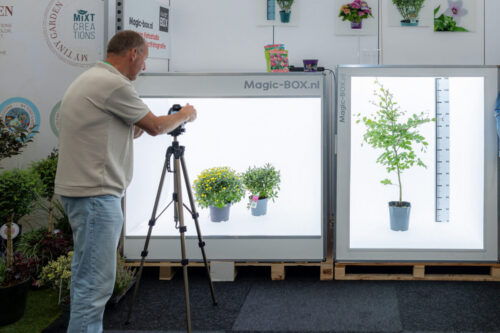
Doing it yourself with the right tools is becoming more and more accessible. With a good lightbox or photo studio, such as the MagicBOX, you can take professional-looking, consistent product photos using a regular camera or even a smartphone—without needing any knowledge of studio lighting or post-processing. For companies that regularly photograph new products, this is often much more efficient and cost-effective than hiring an external photographer every time.
Common Mistakes in Product Photography
Insufficient lighting or the wrong light source, causing colors to look off or creating distracting shadows.
Inconsistent style across different products in the same online store.
Too low a resolution, causing photos to appear blurry when zoomed in.
Unnecessary post-processing, causing the product’s color or shape to no longer match reality—this actually leads to more returns.
Getting Started with Professional Product Photography
Good product photography doesn’t have to be complicated or expensive. With the right preparation and tools, you can take photos on your own that look just as professional as those taken by an outside photographer—and do it whenever it’s convenient for you.
Curious to know how that works in practice?
Curious to see how this works in practice for your collection? Request a free demo at or to view our MagicBOX models.
On our Instagram page you’ll find lots of examples.